Alanton Dock and Bulkhead Permitting for Buyers and Sellers
August 20, 2026
August 20, 2026
Ask an Alanton seller what their dock is worth and you will hear about the view. Ask what happens when a buyer's lender or a title company asks for proof that the dock was ever legally permitted, and the conversation shifts fast. In a neighborhood where a large share of homes sit on Broad Bay, Linkhorn Bay, or the canals that thread between them, the physical structure jutting into the water is rarely the thing that determines how smoothly a sale closes. The paperwork behind it is.
That distinction has carried more weight since last September, when the process for approving new docks, piers, and bulkhead repairs anywhere in Virginia changed for the first time in years. The Virginia Marine Resources Commission, the state agency that has historically received waterfront construction applications, is no longer the front door. The U.S. Army Corps of Engineers now serves as the single point of intake for every Joint Permit Application in the Commonwealth, a shift the Norfolk District confirmed was the result of a federal mandate. For a neighborhood built almost entirely around private water access, that is not a bureaucratic footnote. It is a new layer of due diligence that most buyers do not know to ask about.
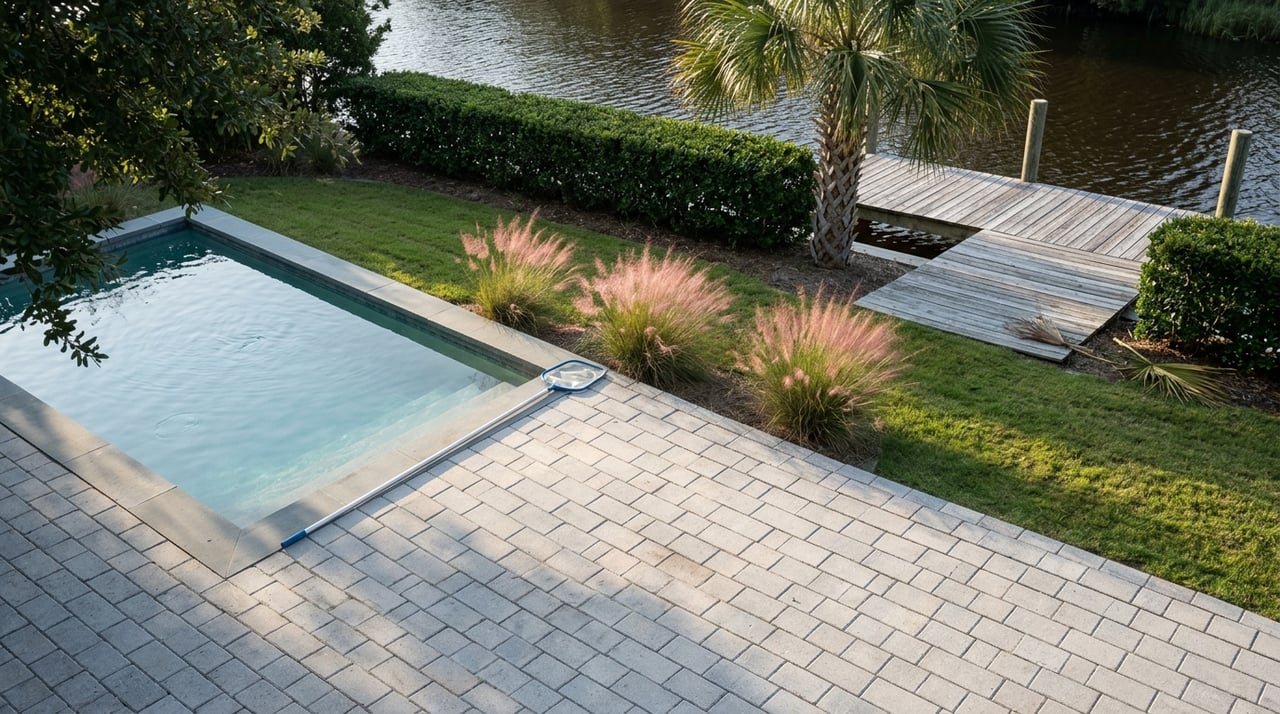
Alanton sits on the peninsula between Broad Bay and Linkhorn Bay, and a meaningful share of its lots back directly onto tidal water with private piers, boat lifts, or bulkheaded shoreline already in place. That density of waterfront infrastructure means Alanton generates more permit activity, historically, than most Virginia Beach neighborhoods without direct ocean frontage.
Before September 2025, a homeowner repairing a bulkhead or extending a pier submitted a Joint Permit Application to VMRC, which then routed it to the Army Corps, the Virginia Institute of Marine Science, and the Virginia Department of Environmental Quality. Now the sequence starts at the federal level. Applications and any revisions move through the Corps' Regulatory Request System first, and VMRC, DEQ, and local wetlands boards review from there. The practical effect for someone buying or selling in Alanton is that any dock work initiated after that date, and any pending application from before it, now has a different paper trail than the one a longtime local agent might expect to find.
Here is the part that surprises most buyers. According to Waterfront Property Law, a "No Permit Needed" letter is issued for roughly 90 percent of the piers and docks built on state-owned bottomland in Virginia. That sounds reassuring until you realize what it means in practice: most docks were never formally permitted in the traditional sense, because the state determined the project fell under a general exemption. The letter itself, or its absence, is the evidence a title company or a careful buyer's agent will look for.
A dock with no letter and no record at all is not automatically a problem. It might simply predate consistent record-keeping, especially on a street where homes go back generations. But it is a question that needs an answer before a contract is signed, not after a survey turns up a structure with no documented authorization.
As a general rule, the Code of Virginia caps most piers at six feet in width, with finger piers limited to five feet, and treats every project beyond that as a case-by-case review.
That single rule of thumb explains why some Alanton docks look modest even on generous waterfront lots. Width limits, not lot size, often set the ceiling on what a homeowner can build without triggering a more involved review.
A standard home inspection does not evaluate a dock or bulkhead. That work sits below the waterline, subject to tidal movement, marine growth, and years of wave action that a home inspector is not equipped to assess. Buyers considering a waterfront property in Alanton should budget for a separate marine survey, distinct from the inspection contingency already built into most purchase agreements.
The cost of building or repairing that infrastructure is not small. Industry pricing cited by the same waterfront law firm puts a typical pier's main section at $125 to $300 per linear foot, with the L-head or T-head platform at the end running an additional $25 to $35 per square foot. A homeowner who inherits a dock in poor condition is not looking at a cosmetic fix. They are looking at a construction project with its own permitting timeline layered on top of the new federal routing.
According to BNB Decks, many lots here carry AE or VE flood zone designations, and any new deck, dock, or bulkhead work has to account for tidal setbacks and existing shoreline structures rather than starting from a blank site. That is a different design problem than building on a dry inland lot, and it is one reason waterfront work in this neighborhood tends to take longer and cost more than a comparable project a few blocks inland.
Even after a project clears state and federal review, Virginia Beach adds its own step. The city's Wetlands Board, a seven-member panel appointed by City Council, reviews any request to construct, alter, or repair a landing, dock, bulkhead, or similar structure within its jurisdiction. That jurisdiction is defined by tide, not by property lines. For non-vegetated wetlands, the board's authority runs from mean low water to mean high water. For vegetated wetlands, it extends further, up to an elevation equal to 1.5 times the mean tide range, which the city sets at roughly two feet for bay and river areas and 3.5 feet for ocean-facing shoreline.
The financial and procedural details worth knowing before you buy or list:
None of this is unique to luxury waterfront. It applies to a modest ranch on a canal lot the same way it applies to a multi-million dollar estate on open bay frontage. What changes is how much is riding on getting it right.
If you are selling a waterfront home here, the strongest thing you can do before listing is pull together whatever permit history exists for the dock and bulkhead, including any prior "No Permit Needed" correspondence, survey records, or contractor invoices for shoreline work. Buyers and their agents are going to ask. Having the answer ready, rather than reconstructing it mid-negotiation, keeps a deal on schedule.
If you are buying, treat the dock the way you would treat an addition without a certificate of occupancy. Ask directly whether the structure has documented authorization, when it was last repaired, and who did the work. If repairs are needed after closing, understand that the application now starts with the Army Corps of Engineers rather than the state agency most local records reference, and that a Wetlands Board hearing depends on a monthly filing deadline rather than same-week turnaround.
The view sells the showing. The permit determines whether the sale closes on time.
Not necessarily. Many older docks fall under the general exemption that produces a "No Permit Needed" letter rather than a full individual permit, and some predate consistent digital record-keeping entirely. The absence of a formal permit is not automatically disqualifying, but it is a question worth resolving before you write or accept an offer.
Your first stop is the Virginia Beach Planning and Community Development Department, which handles Wetlands Board matters and waterfront construction records for the city. State-level history runs through VMRC's Habitat Management Division. A marine surveyor can also assess physical condition independent of paperwork.
Plan for months, not weeks. Between the federal routing change, the required public notice period, and the Wetlands Board's monthly filing deadline, a straightforward bulkhead repair can take one full permitting cycle or more before work begins.
Waterfront property in Alanton rewards buyers and sellers who understand the mechanics behind the water access, not just the water itself. If you are weighing a move onto Broad Bay or Linkhorn Bay, or preparing to list a home with private dockage, Rowland RE can walk you through what the permit history actually shows before you are under contract. Start your tailored market consultation and know what you're buying before the paperwork surprises you.
This article is general information, not legal, tax or financial advice. Consult a qualified professional about your situation.
Stay up to date on the latest real estate trends.

We pride ourselves on providing personalized solutions that bring our clients closer to their dream properties and enhance their long-term wealth. Contact us today to find out how we can be of assistance to you!